
Applications of machine learning - to know as a Beginner
- deepthi s
- Aug 4, 2020
- 4 min read

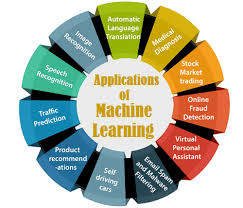
Machine learning refers to learning from experience to improve future performance. The sole focus of this field is automatic learning methods. Machine Learning is external assistance from a human. Many people now interact with systems based on machine learning every day, for instance in image recognition systems, such as those used on social media; voice recognition systems, used by virtual personal assistants; and recommended systems, such as those used by online retailers. As the field develops further, machine learning shows promise of supporting potentially transformative advances in a range of areas, and the social and economic opportunities which follow are significant. In healthcare, machine learning is creating systems that can help doctors give more accurate or effective diagnoses for certain conditions. In transport, it is supporting the development of autonomous vehicles, and helping to make existing transport networks more efficient. For public services, it has the potential to target support more effectively to those in need, or to tailor services to users. And in science, machine learning is helping to make sense of the vast amount of data available to researchers today, offering new insights into biology, physics, medicine, the social sciences, and more. We need machine learning in the following cases: • Human expertise is absent. E. g. Navigating on Mars. • Humans are unable to explain their expertise. E. g. Speech Recognition. • Solution changes with time E. g. Temperature Control. • Solution needs to be adapted to particular cases. E. g. Biometrics. • Problem size is too vast for our limited capabilities. E. g. Calculating web page ranks.
There are three key branches of machine learning:
• In supervised machine learning: The system is trained with data that has been labeled. The labels categorize each data point into one or more groups, such as ‘apples’ or ‘oranges’. The system learns how this data – known as training data – is structured, and uses this to predict the categories of new – or ‘test’ – data.
• Unsupervised learning: is learning without labels. It aims to detect the characteristics that make data points more or less similar to each other, for example by creating clusters and assigning data to these clusters.
• Reinforcement learning: focuses on learning from experience, and lies between unsupervised and supervised learning. In a typical reinforcement learning setting, an agent10 interacts with its environment and is given a reward function that it tries to optimize, for example, the system might be rewarded for winning a game. The goal of the agent is to learn the consequences of its decisions, such as which moves were important in winning a game, and to use this learning to find strategies that maximize its rewards.


Unsupervised Learning :
In machine learning, the problem of unsupervised learning is that of trying to find a hidden structure in unlabeled data. Since the examples given to the learner are unlabeled, there is no error or reward signal to evaluate a potential solution.
>Organizing large computer clusters: At large data centers that are large computer clusters, unsupervised learning helps to figure out which machines tend to work together, so that if those machines are put together or if there is some crisis, then the data centers can work more efficiently.
> Social network analysis: Unsupervised Machine learning algorithms can automatically identify the friends within a user circle in Facebook or Google, or it can identify the maximum number of emails sent to a particular person and categorize into collective groups. It also identifies which are groups of people that all know each other.
Supervised Learning Supervised learning is the machine learning task of inferring a function from labeled training data. The training data consist of a set of training examples. In supervised learning, each example is a pair consisting of an input object (typically a vector) and the desired output value. A supervised learning algorithm analyzes the training data and produces an inferred function, which can be used for mapping new examples.
>Automatic answering of incoming messages: Instead of typing out the same reply every time someone emails with common queries and problems, now machine learning algorithms analyses those mails and automatically generates a reply. This proves useful in the case of large companies.
>Handwriting recognition: It turns out one of the reasons it’s so inexpensive today to route a piece of mail across the countries, is that when an address is written on an envelope, it turns out there’s a learning algorithm that has learned how to read the handwriting so that it can automatically route this envelope on its way, and so it costs less.
Reinforcement learning
Reinforcement learning is an area of machine learning inspired by behaviorist psychology, concerned with how software agents ought to take actions in an environment so as to maximize some notion of cumulative reward.
>Traffic forecasting service: With the ever increasing number of vehicles plying on the roads traffic management seems to a huge problem these days. Machines can be trained and used to solve this problem. For example, systems that overlay predictions about future traffic conditions on a digital traffic flow map. These systems can also be used to know the current and future traffic conditions of a region and also provide users with routing options based on that information.
>Computer games:
The gaming industry has grown tremendously in recent years. AI-driven agents are used widely to create interactive gaming experience for the players. These agents can take a variety of roles such as player’s opponents, teammates, or other non-player characters. Apart from interacting with the human players, a game needs to satisfy a host of other requirements like the audio and visual effects, the gaming environment, etc the different fields of machine learning caters to all these needs and helps programmers develop games that are well suited to the present market demands.


Comments