
Kargil Vijay Diwas
- Nihila.B

- Aug 1, 2020
- 4 min read
Updated: Aug 11, 2020
Kargil war was an armored conflict that took place between India and Pakistan between May and July 1999 in the region of Kargil district of Jammu and Kashmir and along the line of control, also known as the de facto border. This operation was accompanied by the Indian Air force along with the Indian army and was named the Operation Vijay, meaning victory, since the objective was to clear the Kargil zone from the Pakisthan permeators and India succeded after Pakisthan faced international diplomatic opposition.

Before partition of India and Pakistan in 1947, Kargil was a township of Ladakh, skimpy populated but from a variety of lexical, cultural, and moral groups living in isolated valleys divided by some of the world's largest mountains. The Indo- Pakisthan war of 1947-48 left the township sharing a part with Pakisthan, but after the Indo- Pakisthan war of 1971, the two nuclear countries signed "Simla" agreement that no one would fight for that boundary again.
During the initial stages of the war, Pakistan blamed the was entirely on independent Kashmiri insurgents which was later proved that they were Pakistani paramilitary forces led by General Ashraf Rashid. The area of infiltration was about 160 km on the NH1 road connecting Srinagar to Leh which cuts through Kargil. Like other areas of Himalayas, Kargil had continental climate too. Kargil was found as the weaker place since there were a few unoccupied military positions due to freezing temperatures during the season, and also because attacking the defender from high ground in mountain warfare would give a better probability for a win.
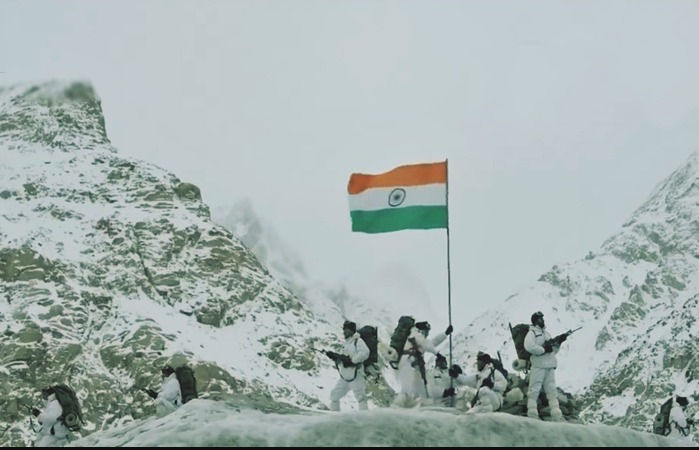
Local shepherds reported the intrusion of the Pakistani group on May 3rd which, to confirm, an Indian army patrol of 5 Indian soldiers was sent and was discovered that they were tortured to death on May 5th. Continuing on May 9th, the Pakistani troops started dumping their ammunition at Kargil and the infiltrations were first discovered at Dras, Kaksar, and Mushkoh sectors. By mid-day, the Indian troop was sent from Kashmir valley to the Kargil sector and the IAF launched airstrikes against the infiltrators on 26th May. Three IAF aircraft, one MiG-21, one MiG-27, and one MI-17 were shot down by Anza Mk-II by the Pakisthan army air defense corps and shells NH1 on June 1. After publishing the records recovered from three Pakistani fighters about Pakistan's involvement, the Indian army set in motion a major attack at Kargil and re-captured two key positions in the Batalik sector on 9th June, and secures Tololing at Dras on 13th June. On 15th June, Pakistani Prime minister Nawaz Sharif was forced to pull down his forces by the US President Bill Clinton in a telephonic conversation. So Pakistani prime minister cut down the supplies of food and weapons for his Pakistani troop so they moved back while the Indian army forwarded towards Tiger hill and launched three prolonged attacks and recaptured it after an 11 hour long battle on 4th July. Following the next day, the Indian army takes control over Dras and Pakistani PM announced the withdrawal of his soldiers. On 7th July, India recaptures Jubar heights at Batalik, its key peaks on July 11th and the Pakistani troop begins at this point to pull out.

On 14th July, the Indian Prime minister Atal Bihari Vajpayee announced Operation Vijay a magnificent win, and the government sets conditions to talk through with Pakisthan. The Kargil conflict officially came to an end and the Indian Army announces complete eviction of the Pakistani infiltrants on 26th July 1999.
From the end of the war until Feb 2000, there was an increase of 30% in the Indian stock market and there were plans for increasing funding for military purposes. The Indians were highly angered after finding especially about Pilot Ajay Ahuja, who was murdered after the constant mutilation of his body.

The war produced higher than expected fatalities from the Indian military with a quite share of newly commissioned officers. A month after the conclusion of the Kargil war, during the Atlantic incident, the Pakistan navy plane was shot down by India.
Later, the Indian government severed ties with Pakisthan and increased defense preparedness. Atal Bihari Vajpayee government set up consortium chaired by K.Subrahmanyam to enquire and analyze the flaws made by the Indian intelligence and was provided with powers to interview anyone with current or past associations with the Indian military, including the former prime ministers. The committee's final report, also known as the "Subrahmanyam Report" led to a large scale restructuring of the Indian Intelligence.

Pakistan army losses had been difficult to determine but they confirmed 453 soldiers killed. India gave its official fatality statistics as 527 dead and 1,363 wounded. The Kargil War memorial, constructed by the Indian Army, is located in Dras, in the foothills of the Tololing Hill. The memorial, located about 5 km from the city center athwart the Tiger Hill, commemorates the martyrs of the Kargil War. The names of the soldiers who sacrificed their lives in the War are chiseled on the Memorial Wall and can be read by visitors. A museum near to the Kargil War Memorial, which was inaugurated to observe the victory of 'Operation Vijay', residence pictures of Indian soldiers, archives of important war documents and recordings, Pakistani war pieces of paraphernalia and gear, and official emblems of the Army from the Kargil war. An enormous national flag, measuring a weight of 15 kg was hoisted at the Kargil war memorial to celebrate the 13th red-letter day of India's win in the Kargil war.

JAI HIND!


Comments